
Digital marketing is the practice of promoting a business, product, or idea through internet-connected channels: search engines, websites, social platforms, email, messaging apps, and paid advertising. Unlike a hoarding or a newspaper advertisement, each of these channels produces data about who saw a message and what they did next. That feedback loop is what defines the discipline. This guide explains what digital marketing includes, how its channels work together, who benefits from it, when each approach makes sense, and where its limits lie. By the end, you will have a clear map of the field and a sensible first step.
What Digital Marketing Means
Digital marketing covers every marketing activity delivered through digital channels to reach a defined audience and prompt a measurable action. That action may be a purchase, an enquiry, a sign-up, a call, or a WhatsApp message.
Three ideas sit underneath the definition:
- Channels: the places where the audience is reached, such as Google Search, Instagram, YouTube, email inboxes, and your own website.
- Targeting: the ability to direct a message at people by interest, location, search query, or past behaviour.
- Measurement: the tracking of impressions, clicks, enquiries, and sales, so decisions rest on observed behaviour rather than guesswork.
Digital Marketing vs Traditional Marketing
Print, radio, and outdoor advertising reach a broad audience and reveal little about which exposure led to a sale. Digital marketing reaches narrower groups and links results to specific actions more closely, although attribution is never perfect: a customer may see an Instagram post, search for the brand days later, and convert through a different channel.
Digital does not replace traditional media in every case. A neighbourhood shop with a loyal walk-in base may gain more from an accurate local listing than from a broad online campaign.
How Digital Marketing Works
The mechanism is a loop with four stages:
- Attract: people find you through a search result, a social post, an advertisement, or a recommendation.
- Engage: a page, video, or message answers their question and builds enough trust for them to continue.
- Convert: the visitor takes the intended action, such as submitting a form or starting a chat.
- Measure and refine: analytics show which channels and pages produced results, and the next round of effort shifts accordingly.
Each channel plays a different role in this loop. Search captures people who already know what they want. Social platforms reach people before they start looking. Paid advertising buys speed, while organic work builds assets that keep working after spending stops.
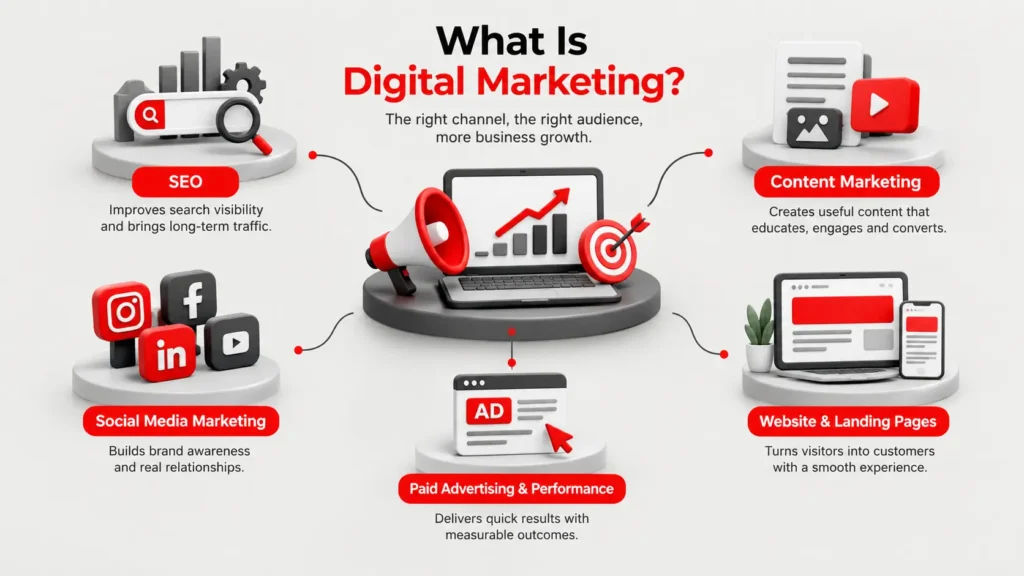
The Main Digital Marketing Channels
Each channel solves a different problem. Knowing the distinctions prevents a common mistake: buying one tactic to fix a problem that belongs to another.
Search Engine Optimisation (SEO)
SEO improves a website’s visibility in unpaid search results. It combines on-page work (content, titles, headings), technical work (crawlability, speed, structured data), and off-page work (earning credible backlinks). It starts slowly because search engines need time to discover and evaluate pages, but traffic is not billed per click. SEO now also extends to answer engines and AI-generated summaries, which extract concise, well-supported answers from pages.
Content Marketing
Content marketing publishes useful material, such as articles, guides, videos, and checklists, for a defined audience. It feeds SEO, gives social media something worth sharing, and supports sales conversations. Its weakness is that volume without a clear audience and search intent produces pages nobody needs.
Social Media Marketing
Social media marketing builds visibility and relationships on platforms such as Instagram, Facebook, YouTube, and LinkedIn. Organic posting builds familiarity; paid social buys reach among chosen segments. For local businesses, the practical question is which platform their customers actually use, not which platform is largest.
Paid Advertising and Performance Marketing
Google Ads places advertisements against search queries and across display, shopping, and video inventory. Performance marketing is the wider approach of paying for measurable outcomes, judged by metrics such as cost per lead, cost per acquisition, and return on ad spend. Results can arrive within days, but they stop when the budget stops, and poorly tracked campaigns can consume money while appearing busy.
Website and Landing Pages
A website is the one channel a business owns outright. Every other channel sends people there, so slow loading, confusing layout, or a weak call to action wastes the traffic those channels produced. WordPress is a widely used platform for this purpose, though the right choice depends on the project’s requirements.
Who Needs Digital Marketing
Any organisation whose customers search, compare, or communicate online can benefit. Typical groups include:
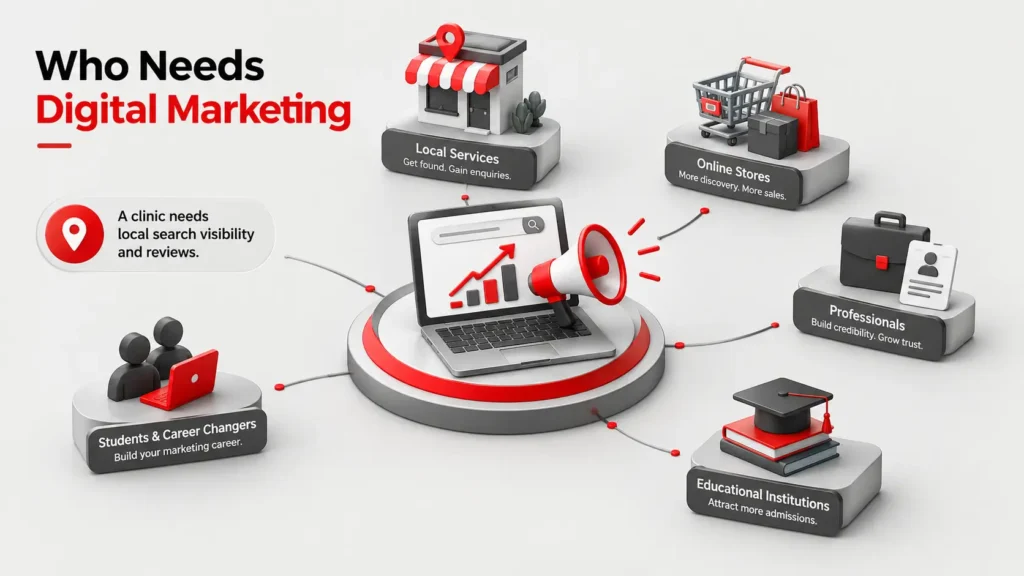
- Local service businesses that depend on enquiries.
- Online stores that need product discovery and repeat purchases.
- Professionals and consultants building credibility.
- Educational institutions seeking admissions.
- Students and career changers who want to work in marketing.
Emphasis differs by group. A clinic usually needs local search visibility and reviews; an online store needs product listings and remarketing; a consultant needs content that demonstrates expertise.
When to Use Which Approach
Channels mature at different speeds, so timing shapes the choice:
- Leads needed within weeks: paid search or paid social, once conversion tracking is working.
- Durable traffic over many months: SEO and content marketing.
- New brand with little recognition: social media and video.
- Existing customers: email and messaging for repeat purchases.
No universal timeline exists. How quickly a channel delivers depends on competition, budget, website quality, and the audience.
Benefits and Limitations
Digital marketing offers real advantages:
- Targeting by intent, location, or interest.
- Spending that can scale up or down.
- Data showing what works and what does not.
- Short paths from first contact to conversation.
It also has limits:
- Competition for attention raises advertising costs.
- Platform algorithms and policies change without notice.
- Attribution across channels is imperfect.
- Results depend on the offer; marketing cannot rescue a weak product.
How to Start
A workable first sequence looks like this:
- Define one business goal, such as monthly enquiries.
- Identify the audience and the questions it asks.
- Fix website basics: speed, mobile layout, and one clear call to action.
- Install tracking, including Google Analytics 4 and conversion events.
- Choose one or two channels that fit the goal and budget.
- Review results at fixed intervals and adjust.
Start narrow. Five channels run thinly teach less than two run properly, because each channel needs enough budget and attention to produce readable data.
Frequently Asked Questions
What is digital marketing in simple terms?
Digital marketing is promoting a business through online channels such as search engines, social media, email, and paid ads, then measuring how people respond. The measurement is what separates it from older advertising formats.
Is digital marketing the same as SEO?
No. SEO is one channel within digital marketing, focused on unpaid search visibility. Digital marketing also includes social media, paid advertising, content, email, and website optimisation.
How long does digital marketing take to show results?
Paid campaigns can generate traffic within days, while SEO usually takes months because search engines must discover and evaluate new content. Competition, budget, and website quality all change the timeline.
Do small businesses need a large budget?
No fixed minimum exists. Budget should reflect what a customer is worth to the business. Starting with one well-tracked channel limits waste and shows what is working before spending more.
What skills does a digital marketer need?
Core skills include writing, analytics, understanding search intent, platform knowledge, and the discipline to test changes one at a time. Tool knowledge matters less than the ability to interpret results.
Conclusion
As a Digital Marketer digital marketing works best as a connected system: channels attract, the website converts, and data guides the next decision. Begin with one goal and one or two channels, then expand based on evidence rather than habit. Revisit the plan as results come in. If you want help choosing which channels suit your business, a WhatsApp consultation is a sensible next step.