
A strong online presence lets customers find your business, trust what they see and contact you without effort. For a Kerala business, it rests on five assets: a complete Google Business Profile, a fast website with a page for each service, content that answers local searches, genuine reviews and one or two promotion channels chosen for your goal. This guide explains what each asset does, who needs which one first, when to add paid ads and how to build the presence step by step.
What an Online Presence Includes
An online presence is every place where a customer can discover, evaluate or contact your business online. Four layers carry most of the weight:
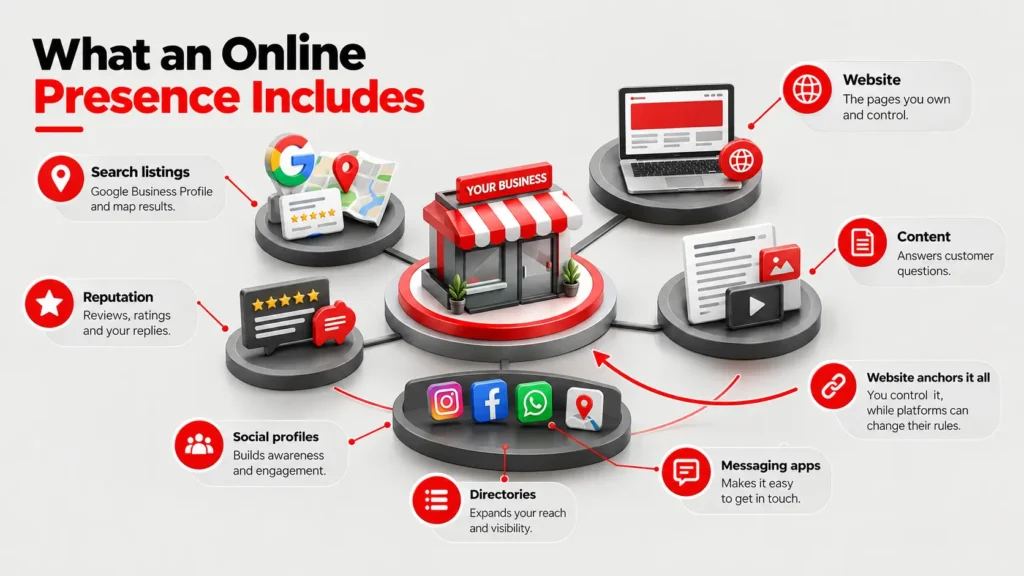
- Search listings: your Google Business Profile and map results.
- Website: the pages you own and control.
- Content: pages and posts that answer customer questions.
- Reputation: reviews, ratings and your replies.
Social profiles, directories and messaging apps such as WhatsApp sit around these layers. The website anchors them because you control it, while platforms can change their rules at any time.
Why It Matters in Kerala
Buyers research on their phones before they call. A BMJ Global Health paper from 2021 reported 95% mobile phone and 62% smartphone penetration in Kerala. Those figures are several years old, so treat them as a direction, not a current count.
Local results also reward completeness. Google guidance says local ranking depends mainly on relevance, distance and prominence, and that full business details and positive reviews help. The same page states that nobody can pay for a better local ranking. The work is earned through accuracy and consistency.
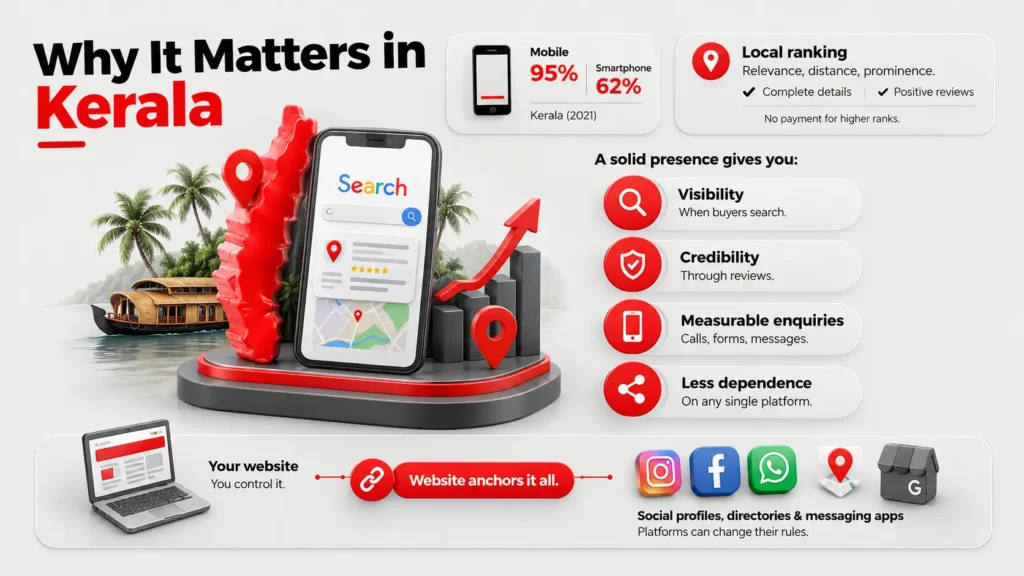
A solid presence gives you:
- Visibility when buyers search for your service and locality
- Credibility from consistent details and reviews
- Measurable enquiries through calls, forms and messages
- Less dependence on any single platform
No presence guarantees rankings. Results depend on competition, site condition and steady effort.
Who Needs Which Asset First
Businesses that customers compare nearby, such as clinics, schools, coaching centres, hotels, jewellers and repair shops, need the Business Profile first. Online sellers and businesses serving other states or countries need the website and search content first, because their buyers do not sit in one locality. Their targeting should follow the buyers’ regions and languages, not only Kerala.
A business without a website can start with a Business Profile and add a site once it can handle the enquiries. One that cannot answer calls and messages promptly should fix that before paying for promotion, because new leads will otherwise go unanswered.
How to Build It in Six Steps
Set Up Your Google Business Profile
Claim the listing, choose accurate categories and add the address, phone number, hours, services and photos. Keep the business name, address and phone number identical on your website and in directories. Google says businesses with complete, accurate information are more likely to appear in local results.
Build a Website That Produces Enquiries
Give each service its own page with a clear title, location details and a visible contact option. Make every page load quickly on mobile. Professional web design covers layout, speed and structure, and SEO services cover the technical and on-page setup that lets Google read the site.
Publish Content That Answers Local Searches
Write for the questions buyers ask: cost, process, comparisons and location. Give “what is” searches and “price” or “hire” searches separate pages, since each serves a different need. Google advises people-first content, written to help readers rather than manipulate rankings. Check Search Console queries to see whether your customers search in Malayalam, English or both. Content writing keeps these pages consistent.
Collect and Answer Reviews
Ask satisfied customers to review you on Google, and reply to every review politely, including negative ones. Google lists review count and score among the signals behind prominence. Do not buy or fabricate reviews.
Add Ads and Social Media Selectively
Paid ads test demand faster than organic work, but results stop when the budget stops. Google Ads suit searches with clear buying intent, and negative keywords exclude irrelevant queries, although Google warns that too many can reduce reach. Social media suits visual products and repeat customers. Performance marketing ties spend across platforms to a cost-per-lead or cost-per-sale target.
Measure What Matters
Track calls, form submissions, messages and Business Profile actions, then compare them with Search Console impressions and clicks. Set a monthly target for calls or form submissions before launch, so every review compares results against a stated goal. Review the numbers monthly and move effort toward what produces enquiries.
Comparing the Main Channels
| Channel | Best for | Time to results | Main limit |
|---|---|---|---|
| Google Business Profile | Businesses serving a defined area | Gradual | Rankings cannot be bought or guaranteed |
| Website and SEO | Repeated searches for services | Gradual, no fixed date | Needs steady content and upkeep |
| Google Ads | Testing demand for one service | Starts once campaigns run | Results stop when spend stops |
| Social media | Visual products, repeat customers | Varies | Followers do not equal enquiries |
When to Start and When to Get Help
Start before launch, or when visits arrive but enquiries stall. Revisit the plan each quarter and before a seasonal peak in your sector.
Consider outside help when nobody on your team can read Search Console or analytics data, when ad spend has no tracked leads, or when several channels need coordination. Compare providers on four points:
- A written plan before work begins
- Sample reports that show enquiries, not only rankings
- Direct access to the person doing the work
- No ranking guarantees, since search engines make the final decision
The Aranyaveda case study shows how web design, SEO and a Business Profile can work together for a Trivandrum treatment centre. To review your own setup, contact me.
Mistakes That Waste Effort
- Letting business details differ between the Profile, website and directories
- Putting every service on one page
- Sending ad clicks to the homepage instead of a matching page
- Reporting followers and impressions instead of enquiries
- Ignoring reviews and unanswered messages
- Accepting link packages or ranking guarantees
Frequently Asked Questions
How long does it take to build an online presence?
A basic setup, with a Business Profile and core service pages, can go live within weeks. Rankings and reviews build gradually, and timing depends on competition and site quality, so no one can responsibly promise a fixed date.
Do I need a website if I have a Business Profile or Instagram page?
Usually yes. A website gives each service its own page, supports search visibility and does not depend on platform rules. Profiles help people find and contact you, but they cannot replace pages you control.
Should I write in Malayalam or English?
Follow your customers’ searches. Check Search Console queries and customer messages to see which language they use, then publish in that language, or in both when your audience splits.
How much should I spend?
No standard figure fits every business. Set a target result, estimate what one enquiry is worth and test a small budget first. Ad spend goes to the platforms and stays separate from any provider’s fee.
Can anyone guarantee a top Google ranking?
No. Google states that nobody can pay for a better local ranking, and search engines make the final decisions. Treat any promise of a fixed position or traffic number with caution.
Is social media enough on its own?
Rarely. Social platforms suit visual products and repeat customers, but they depend on feeds and platform rules. Pair them with a website and Business Profile so buyers searching for your service can also find you.